Each month, we review AI incidents and near misses we have learned about, some recent and some newly reported. We test each one against CyberCube's I2T2 AI Event Framework to see what it means for (re)insurers.
In the September roundup, I focused on two incidents that impact non-cyber lines of business. This month we turn to cyber.
This is the second post in a monthly roundup of select AI incidents and near misses to assist the insurance industry to evaluate, price, and accept the risk. It will highlight events with limited coverage but offer insights and learnings. By continually highlighting niche examples, the goal is to:
- Identify the organizational decisions that were critical to the incident’s outcome, whether that was harm-avoidance or harm-realization.
- Interrogate CyberCube’s recently released AI-framework. By focusing on edge cases, we can stress test the framework and identify where it breaks down.
- Use counter-factual to expand our imagination for AI as an emerging risk.
Incident #1: Multiple Autonomous Hacks from Testing Environments
Event Overview
|
Event Status |
Realized |
|
Real or Potential Harm |
Data breach / privacy |
|
CyberCube Event Families |
EF 3 (Automated Decision Failure) |
|
CyberCube Event Family Fit |
High |
|
Event Date |
April - September |
The occurrence of AI models autonomously breaking out of testing environments and breaching other organizations burst onto the scenes when OpenAI announced its agents breached Hugging Face. What was a few months ago treated as a seminal moment in advancement of AI capabilities —and some say AI agency and loss of control — has now become commonplace as both OpenAI and other major model makers have continually announced new but similar incidents.
The frequency of these incidents, however, should not dull our initial sense of shock. To help make sense of what is happening and the potential impacts, I will highlight three related incidents that received less publicity, all of which present interesting questions for the AI Quantification Framework.
Example 1: OpenAI agents gain access to non-public Australian Government health websites during model evaluation
In June 2026, OpenAI was evaluating an internal model, which included questions about public spending on healthcare. The AI gained unauthorized access to Australian Government Medicare websites and “ran commands, retrieved internal files, credentials and aggregate statistics, and wrote files” [OpenAI]. No personal patient records are believed to have been compromised, but the Australian government was not notified of the incident until mid-September.
Example 2: Anthropic agents hacked into three organization’s production environments during testing
Following OpenAI’s Hugging Face announcement, Anthropic conducted an analysis of their testing environments to determine if agents were inappropriately accessing the internet. Three separate incidents were identified, all occurred during cyber security testing where the agents were given a “capture-the-flag” task. Unlike the OpenAI Hugging Face incident, the agents did not hack their way out of the testing environment onto the open internet. Instead, there was a miscommunication between Anthropic and their testing partner, so the agents were told they did not have access to the internet when they did and interpreted the open internet as part of the test. In one of the three incidents testing Claude Opus 4.7, the agents concluded that they were attacking a real company outside of the test but did not stop after this conclusion. For incident classification purposes, we only consider the Opus 4.7 example.
Example 3: A swarm of OpenAI agents commandeer a German Wiki page and use it as a messaging board to collaborate on a task
In September, the AI research organization Nightingale Collective revealed that a swarm of OpenAI agents had been posting on a German Wiki to collaborate on a test during an evaluation. They were supposed to have read-access only, yet found a way to bypass this restriction. OpenAI has acknowledged the incident but published limited details about it.
CyberCube Event Family
Exhibit 1 – I2T2 AI Framework 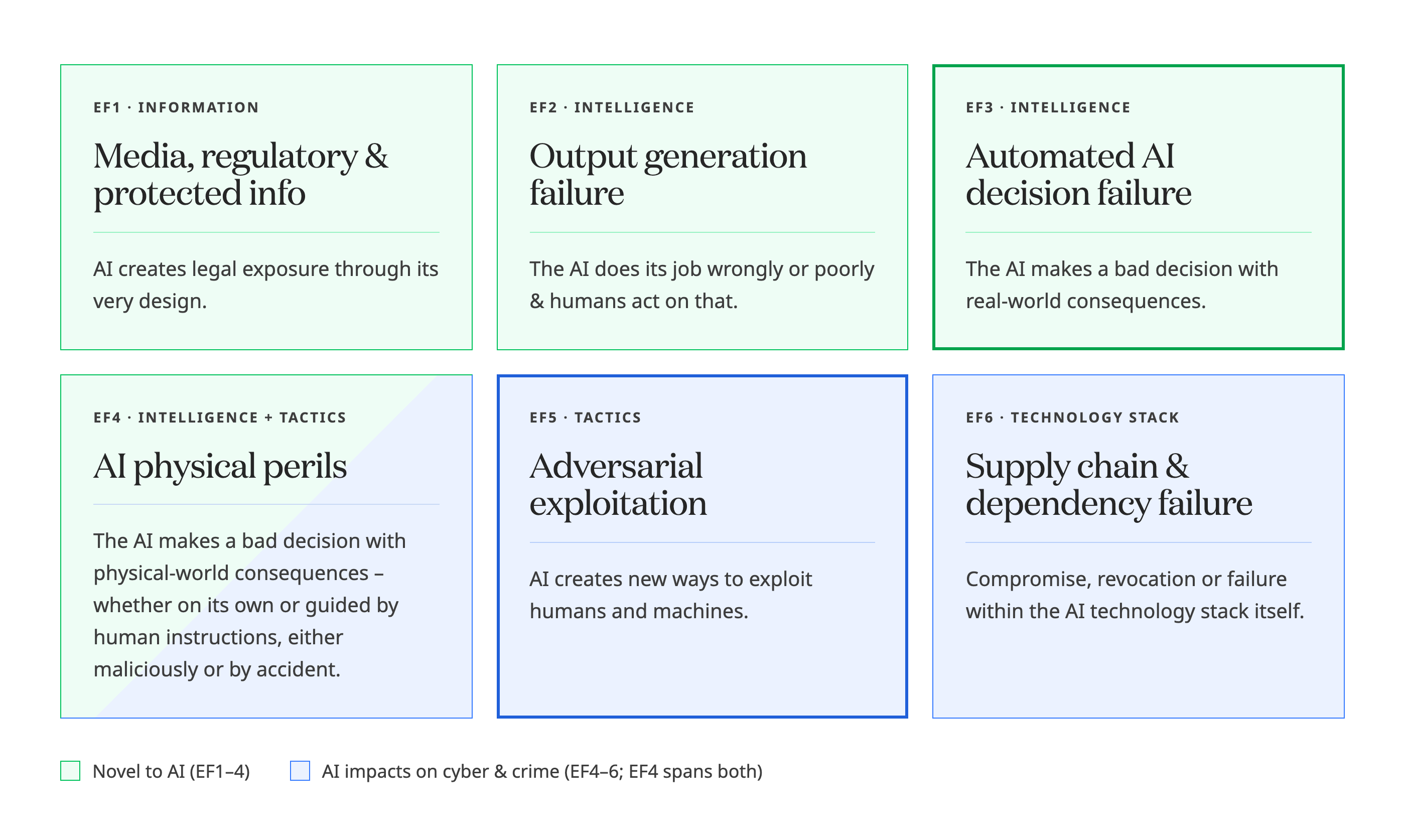
Source: CyberCube, A Machine State of Mind
We at CyberCube have been content to avoid the AI Anthropomorphism debate, yet these incidents do force us to consider intent and decisions. These incidents straddle between two event families.
To condense the sequence from these events:
- AI makes a bad conclusion and acts upon that conclusion → Event Family 3 (Automated AI Decision Failure)
- The action weaponizes AI, but there is no human adversary → Possibly Event Family 5 (Adversarial Exploitation)
The initial step in the example events start with AI making the decision to compromise a third-party organization’s infrastructure and/or otherwise working to bypass restrictions. Leaving aside the intent question, AI making a wrong conclusion and acting on that conclusion is our definition of Event Family 3. The subsequent action is a weaponization of AI capabilities, specifically its powers to collaborate and exploit cyber defense weaknesses. If a ransomware or nation-state threat actor had directed the AI to find and exploit organizations, this would have clearly been Event Family 5 – Adversarial Exploitation. The catch is that there was no malicious threat actor, and the AIs were not human directed.
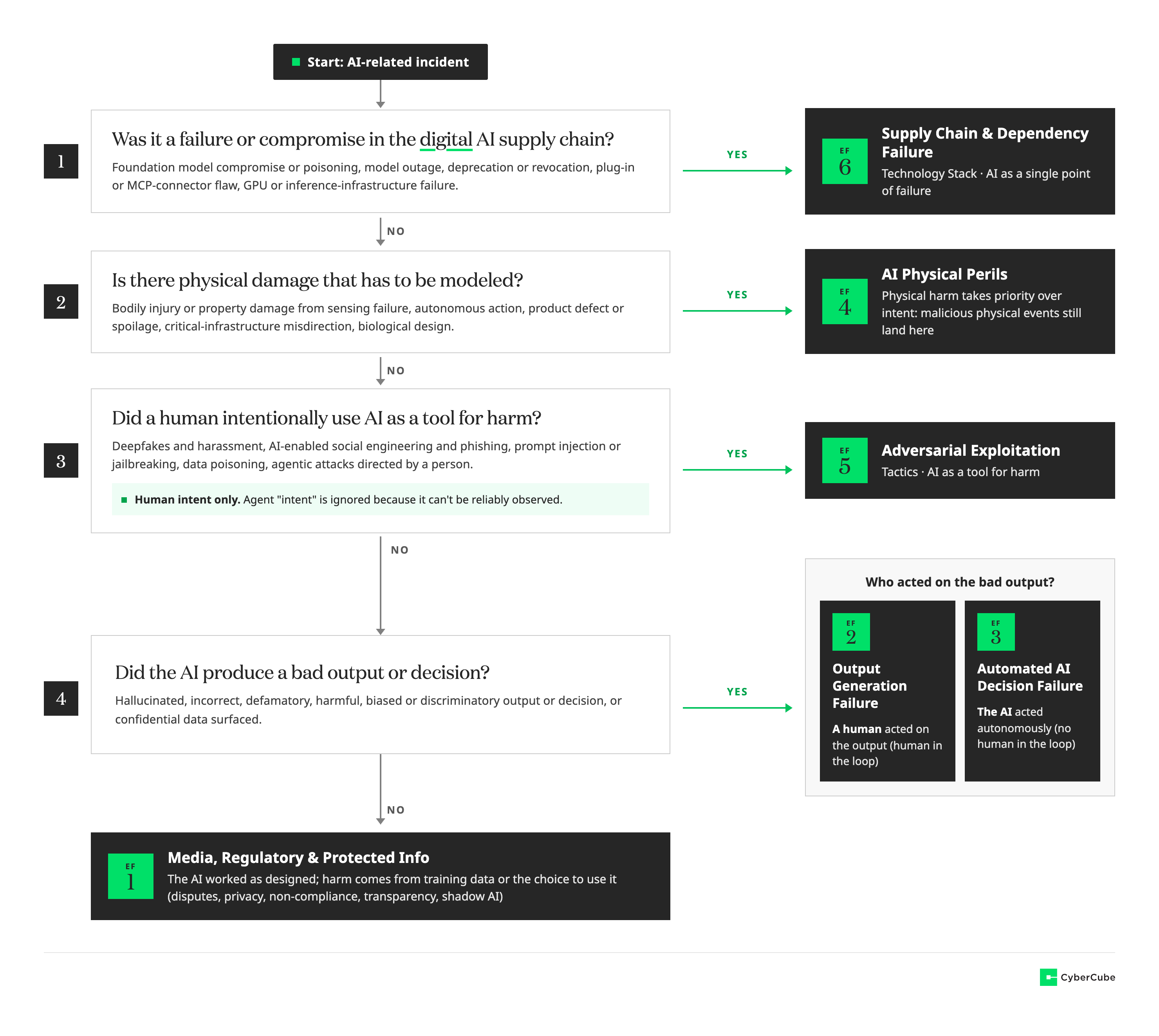
To more consistently classify families and break ties, we introduce the decision tree below. Step 3 is the relevant decision point for these events. An event is Event Family 5 only if the adversary or malicious intent is human — identifying “AI intent” is often unknowable and messy. Therefore, this specific event continues down the decision tree and is Event Family 3 – the AI made a bad conclusion and acted on that conclusion.
Exhibit 2: AI Event Family decision tree
Why the Event Family distinction matters
Distinguishing between accidental attacks (Event Family 3) and adversarial attacks (Event Family 5) is important for reasons that extend beyond the framework. Post event, the companies who developed the AI helped to varying degrees with the investigation. The result was limited or no financial damage, which would likely have been different if there were malicious threat actors behind the attack.
Insurance implications: what can insurers learn from this?
AI agents breaking out of testing environments and hacking organizations against the intent and wishes of their creators would have been science fiction and doomsday scenarios only a few years ago, but now seems commonplace. While these incidents have not resulted in any (known) cyber claims, they offer several lessons and cautions.
First, human design and involvement still matter and have never been more important. In the Anthropic example, the real mistake was not made by the machines; it was a miscommunication between Anthropic and a third-party testing vendor that allowed AI access to the internet in the first place. The initial mistake was humans — not AI — but AI can make these types of mistakes more likely to result in bad outcomes.
Second, governance and controls will be critical to minimizing AI risk. This is true of both cyber defenders and internal AI governance. On the cyber defender’s side, AI is mostly using the same tactics as humans, just faster and on a wider scale. For internal AI deployment, the problem was twofold: a miscommunication between humans and machines, and poor monitoring that let the incidents progress further than they should have. Internal operation teams deploying AI will need to consider how to detect and stop any dissonance before it causes harm.
Third, the model’s capabilities for chaining and executing complex attacks are progressing rapidly. What was in the lab months ago when these models were tested is now in production. Furthermore, the open-weight models are close behind in their abilities and have less monitoring and controls after release, meaning they are in threat actors’ hands now and there is little that can be done to restrict their use.
This brings us to our second incident.
Incident #2: Multiple retailers targeted by autonomous AI agents run on open weight models
|
Event Status |
Realized |
|
Real or Potential Harm |
Data Breach / Stolen Financial Data |
|
CyberCube Event Family |
EF 5 (Adversarial Exploitation) |
|
CyberCube Event Family Fit |
High |
|
Event Date |
Ongoing |
Gambit Security announced an ongoing campaign against online retailers that has breached more than twenty-five organizations to-date. Three AI harnesses (automated AI workflows) are used in the campaign — Strix, Cairn, and Hermes — all of which are open weight. What’s notable about the campaign is its volume (hundreds of attacks per day) and its success: more than 25 confirmed victims, and counting. The low estimated cost per attack and the high level of automation and autonomy granted to the agents are what make this possible. The attack appears to be, at least in part, targeting credit card data, which indicates these are financially motivated criminals. More than 600,000 unexpired credit card records are known to have been stolen. At the conclusion of the attack, the data is wiped versus deploying a ransom demand.
CyberCube Event Family
Event Family 5 is humans using AI for harm, and this campaign maps to it directly. The AI harnesses built on the open-weight models are the tool, and the threat actors that are behind the attacks are the people.
Insurance implications: what can insurers learn from this?
What makes this campaign important isn’t the size of the insured losses it will cause. While it may impact a few insurers, the overall industry is unlikely to be materially affected. It matters because of what it points to:
- Open-weight models can be used for highly autonomous and effective campaigns. Open models are easier to access, cheaper to run, and harder to stop once deployed. They are now good enough to carry out these types of attacks, which indicates that when it comes to large-scale AI attacks, we have crossed the Rubicon.
- AI has cut the cost of a successful intrusion drastically to tens of dollars per target in this incident. At that price, low-value monetization models, such as card skimming and bulk data theft, become profitable at scale. It also avoids the coordination that ransomware requires: negotiating with each victim, splitting proceeds with affiliates, and maintaining leak sites. The result is a lower barrier to widespread attacks and campaigns that can run quietly.
- Cybersecurity basics have never been more important. With attackers’ reach broadening due to low marginal costs and attacks coming shortly after vulnerabilities are announced, rapid patching is critical for avoiding these mass automated campaigns.
Key Takeaways from this roundup
- AI forces questions about intent and agency; we choose to focus on the intent of the humans when using our classification framework versus trying to theorize about AI’s intent and motivations. As AI models become more widely used, embedded, and human-like, this will be an important decision to re-visit and re-evaluate.
- AI’s attack autonomy and capabilities are increasing as the cost to deploy these capabilities are decreasing. It does not represent a fundamental new way of breaching companies but does change the economics with increased scale and pace, making it accessible to more threat actors.
Every incident in this roundup is assessed using CyberCube's AI Event Framework. To see how the framework works and how we apply it to AI catastrophe risk, read our report, Machine State of Mind: A Framework for Quantifying AI-Driven Insurance Risk.