.png)
Recent Linux kernel vulnerabilities, including Copy Fail (CVE-2026-31431) and the Dirty Frag issues (CVE-2026-43284 and CVE-2026-43500), are drawing attention because they allow someone with limited access to a Linux server to turn that access into full control of the system. Once that happens, they can do anything on that machine.
A core concern in cloud security has long been the possibility that an attacker could escape one environment and impact others on shared infrastructure. While this has historically been difficult and major providers patch quickly, vulnerabilities like Copy Fail and Dirty Frag show that isolation could still be bypassed, potentially affecting multiple customers at once. As a result, this remains a fundamental cloud security fear.
Linux servers are critical because they run a large portion of the internet and cloud services. They underpin systems that businesses and essential infrastructure rely on every day. The impact of these vulnerabilities could include ransomware, data theft, business interruption, and generally attackers controlling critical systems or services.
How Widespread is Potential Exposure?
CyberCube's analysis of 100,000 U.S.-based companies with revenues of $10M+ found at least 50% are directly or indirectly exposed to potentially vulnerable Linux technologies. This figure is likely conservative, as direct deployments of Linux are easier to detect than indirect dependencies. Given that most organizations rely on Linux indirectly in some form, the true share of exposed entities is potentially even higher. Additionally, we identified exposure using a subset of Linux-related technologies associated with Copy Fail and Dirty Frag, which does not capture all affected environments.
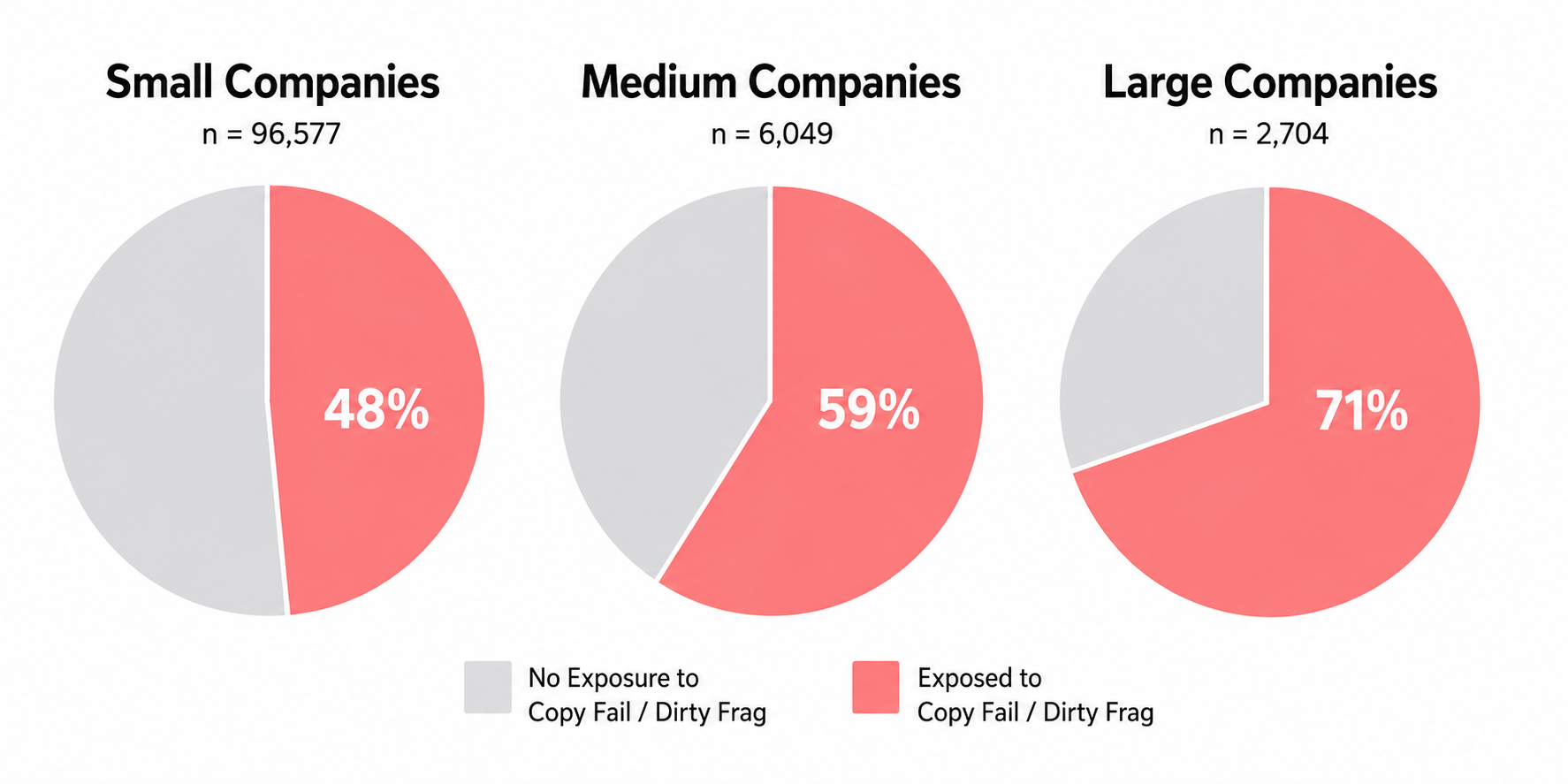
We found that exposure to Copy Fail and Dirty Frag vulnerabilities increases with how much infrastructure a company operates, even though dependency-driven exposure exists across all sizes (See Exhibit 2). Additionally, this is not a sector-specific issue; Linux-related exposure is broad and systemic, with some sectors facing higher concentrations but no industry being immune (See Exhibit 3).
Today, we are at a stage where attackers have started incorporating Copy Fail and Dirty Frag vulnerabilities into their attack chains. Copy Fail has been added to CISA’s Known Exploited Vulnerabilities (KEV) catalog, indicating active exploitation. Microsoft is seeing in-the-wild threat activities associated with either Dirty Frag or Copy Fail.
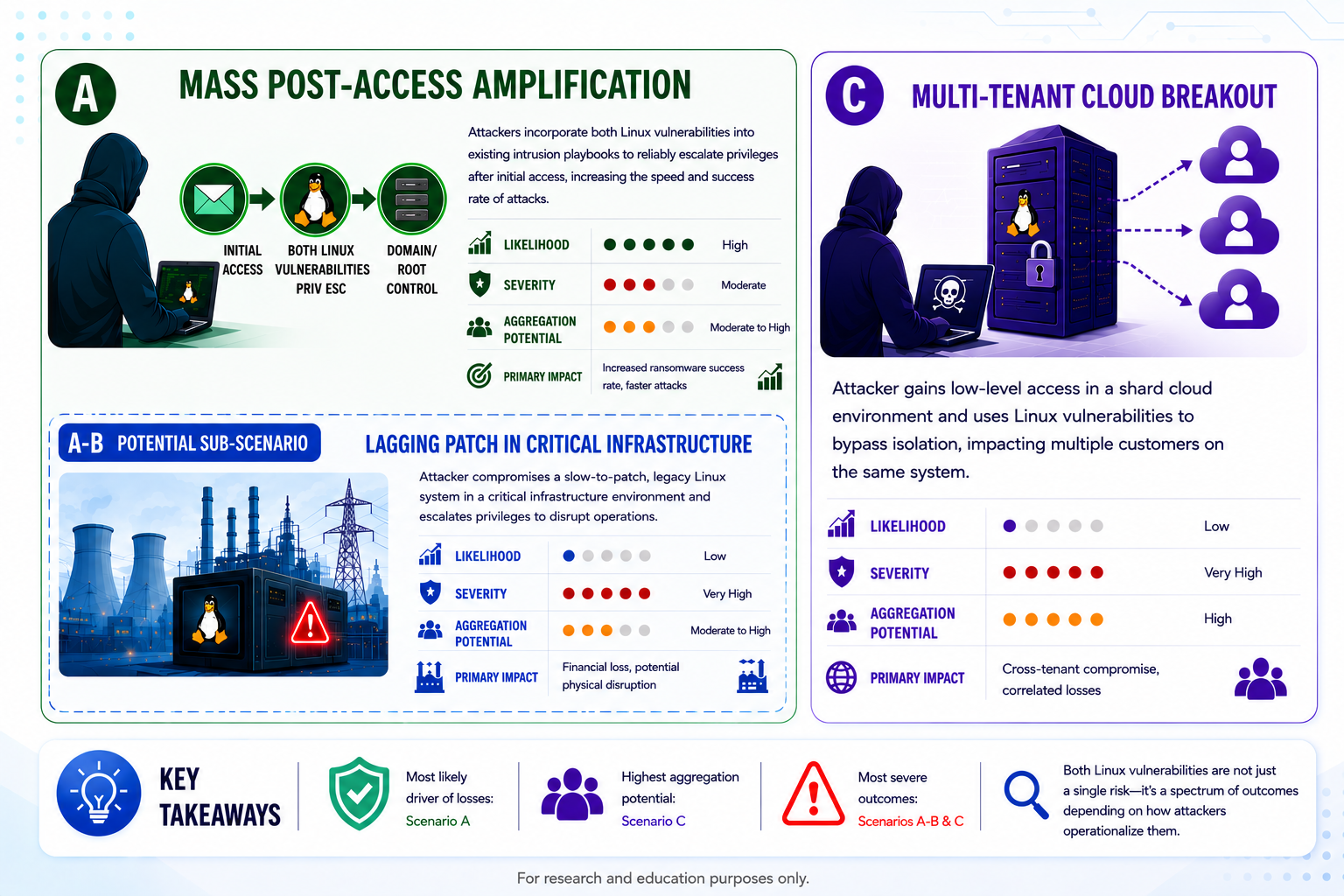
According to Microsoft, these new Linux vulnerabilities do not spread on their own and can not be exploited directly from the internet. Consequently, they are unlikely to lead to a fast, large-scale event. At the same time, major cloud providers and more mature organizations have patched quickly, which reduces the chance of a widespread major cloud incident. Today, the big risk is a steady increase in successful attacks across many organizations, rather than one big headline-grabbing event (See Exhibit 1).
Recently disclosed issues like Dirty Frag expand the risk by providing additional paths to escalate access on unpatched Linux systems. U.S. Federal Civilian Executive Branch (FCEB) agencies have been ordered to patch by May 15, 2026.
Going forward, these vulnerabilities present risk scenarios (re)insurers need to understand.
Potential Copy Fail Cyber Risk Scenarios
Exhibit 1: Key Copy Fail & Dirty Frag Vulnerability Risk Scenarios (5/11/2026)
The most likely scenario is one in which threat actors incorporate both vulnerabilities into existing playbooks.
Source: CyberCube Concierge Threat Intelligence Service, May 2026
Scenario A (Mass Post-Access Amplification) is the most likely risk scenario because it aligns with how attacks already work. After gaining initial access through methods like stolen credentials or phishing, attackers need to escalate privileges to take control of a system. Copy Fail and Dirty Frag provide reliable ways to do this, making attacks faster, more consistent, and easier to repeat across targets. This could drive higher success rates for ransomware and extortion across a wide range of organizations; essentially any company running Linux systems.
A–B (Sub-scenario: Lagging Patch in Critical Infrastructure) represents a high-severity extension of Scenario A. In environments where patching is slow, particularly in critical infrastructure, an initial compromise can escalate into full system control and operational disruption. This primarily affects sectors such as energy, utilities, manufacturing, healthcare, transportation, and government systems that rely on long-lived or specialized Linux deployments. While Linux is widely used in these environments because it is stable, flexible, and cost-effective, these same characteristics often lead to systems that are harder to patch, allowing vulnerabilities to persist.
Scenario C (Multi-tenant Cloud Breakout) is less frequent but more systemic. Here, a foothold in a shared cloud environment could extend across multiple tenants and create correlated losses. In shared hosting environments where workloads run on the same underlying Operating System (OS), Linux vulnerabilities can bypass isolation controls, increasing the risk of cross-tenant compromise and simultaneous impact. This scenario is most relevant to cloud providers, SaaS platforms, Managed service and hosting providers, and companies operating multi-tenant or containerized environments.
While ongoing patching and the time since disclosure may reduce the chances of attackers turning these vulnerabilities into repeatable, large-scale attacks affecting many organizations at once, uneven patch adoption and continued reliance on shared systems mean that more serious outcomes are still possible. For (re)insurers, this reinforces the need to track insureds’ reliance on Copy Fail and Dirty Frag exposed technologies and how attackers are behaving across the three potential scenarios.
U.S. Companies Across Sizes and Sectors are Exposed
CyberCube analyzed over 100,000 U.S.-based companies with $10M+ in annual revenues from its Standalone Insurance Exposure Database (IED), identifying ~52,000 (~50%) as higher risk due to exposure to Copy Fail–associated technologies. We looked at technologies such as cPanel and Linux distributions (e.g., AWS Linux, Red Hat, Ubuntu, etc.). This higher-risk population was then segmented by company size to evaluate whether exposure varies across size.
Note, we identified exposure using a subset of Linux-related technologies associated with Copy Fail and Dirty Frag, which does not capture all affected environments.
Exposure rates were calculated within each size segment by dividing the number of exposed companies by the total number of companies in that size group in the overall portfolio, allowing for exposure rate comparison across small, medium, and large.
Exhibit 2: Share of Entities Exposed to Copy Fail / Dirty Frag by Company Size
Large companies account for the highest share of technology exposure to Copy Fail and Dirty Frag, with notable exposure across all sizes.
Source: CyberCube U.S. Industry Exposure Database (IED), Single-Point-of-Failure Intelligence (SPoF)
Data: n= 105,330 companies, small = 96,577, medium = 6,049, large = 2,704
Technologies observed: (one or more of the following) cPanel, cPanel SSL, Linux, RedHat Enterprise Linux, AWS Linux, AlmaLinux, Ubuntu, SUSE, Rocky Linux, Cent OS, Debian
Exposure to Copy Fail and Dirty Frag vulnerabilities increases with how much infrastructure a company operates, even though dependency-driven exposure exists across all sizes.
Small companies are exposed indirectly through cloud platforms, hosting providers, or SaaS, even if they don’t manage Linux themselves. Medium companies are in between, with both indirect exposure and some systems they run and manage as they grow.
Large companies rely heavily on Linux and operate it across many environments, so they have both direct and indirect exposure at scale. As a result, exposure rises with size, not because small companies are unaffected, but because larger organizations use and depend on these systems much more extensively and directly.
Exhibit 3: Share of Copy Fail / Dirty Frag Vulnerable Entities By Industry Segment
Telecoms, manufacturing, education, and marine show the highest levels of exposure.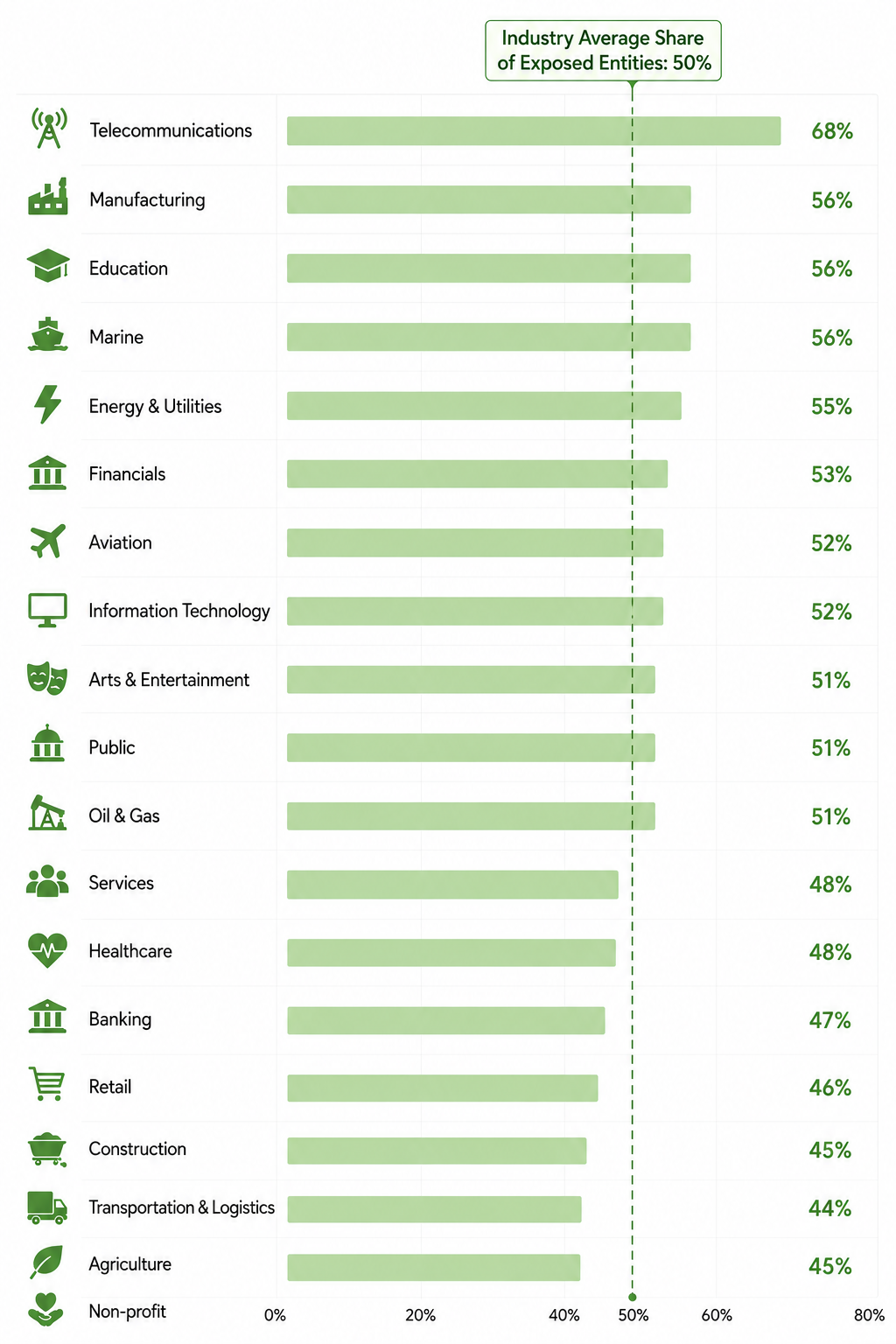
Source: CyberCube U.S. Industry Exposure Database (IED), Single-Point-of-Failure Intelligence (SPoF)
Data: n= 105,330 companies
Technologies observed: (one or more of the following) cPanel, cPanel SSL, Linux, RedHat Enterprise Linux, AWS Linux, AlmaLinux, Ubuntu, SUSE, Rocky Linux, Cent OS, Debian
The key takeaway is that this is not a sector-specific issue; Linux-related exposure is broad and systemic, with some sectors facing higher concentrations but no industry being immune.
Telecommunications stands out with the highest share (68%), reflecting its heavy reliance on Linux-based infrastructure, while sectors like manufacturing, education, energy, and financials also show elevated exposure levels.
Even traditionally less technical sectors, such as retail, transportation, and agriculture, still have substantial exposure, highlighting how deeply embedded Linux technologies are across the economy.
Non-profits appear less exposed mainly because they tend to rely more on cloud tools, SaaS platforms, and hosted services instead of managing Linux systems directly. This results in lower direct exposure in the data. However, they are still dependent on those systems behind the scenes, so the risk is not absent, it could simply be less visible.
The Bottom Line for Cyber (Re)insurers
For (re)insurers, the key question is whether this remains a limited issue or becomes something that can be used at scale across many organizations at once.
A helpful way to think about this is how attackers combine steps to carry out an attack. No single vulnerability usually does everything. Instead, attackers link them together. For example, they might first gain access using stolen credentials, then use a vulnerability like Copy Fail to take full control. This is what is meant by “chaining” an attack.
We have seen this before with vulnerabilities like ProxyLogon and ProxyShell, where early activity looked limited but then grew quickly once attackers figured out reliable ways to chain different steps into repeatable attacks.
With Copy Fail, the situation is still evolving. The vulnerability is already being used in real attacks and has been added to CISA’s Known Exploited Vulnerabilities list, with government agencies required to patch quickly. At the same time, fixes are being rolled out across major Linux systems, including updates and temporary safeguards.
This creates an uncertain but familiar pattern. On one hand, it could follow something like Log4Shell, where risk rises quickly and then drops as systems are patched. On the other hand, because these vulnerabilities are easy to use and apply broadly across Linux systems, they are likely to stick around as a reliable step attackers can reuse in many different attacks over time.
What’s Next? The Debate Over AI Vulnerability Discovery
What comes next is a growing debate over the role of AI in vulnerability discovery. The emergence of Copy Fail, reportedly identified with AI assistance, has raised concerns that new tools are making it faster and easier to find deep, long-standing flaws in complex systems like the Linux kernel.
While human researchers are still central, AI is increasingly acting as a force multiplier, helping analyze code, test hypotheses, and surface bugs more quickly. This has led to a broader debate about whether upcoming models, such as Anthropic’s “Mythos,” could accelerate a wave of vulnerability discovery at a pace defenders struggle to keep up with, sometimes described as a potential “vulnerability apocalypse.”
However, some security researchers are not convinced this outcome is inevitable, arguing that real-world discovery still requires domain expertise, validation, and context that AI alone does not yet reliably provide.
The open question is whether Copy Fail and Dirty Frag are isolated discoveries or early indicators of a broader shift in how vulnerabilities are found and exploited. If they are isolated, their impact will likely follow a familiar pattern of short-term urgency followed by gradual decline as patching takes effect.
However, if they reflect a deeper pool of similar, long-standing flaws in widely used systems like the Linux kernel, or a sustained increase in discovery driven by improved tooling and AI assistance, then they may signal a more persistent change in the threat landscape. In that scenario, organizations would face a steady pipeline of comparable vulnerabilities over time, each reinforcing attacker capabilities.
The distinction matters because it shapes whether this is a temporary spike in risk or part of a longer-term trend, though it is still early to draw firm conclusions.
.png)

.png)